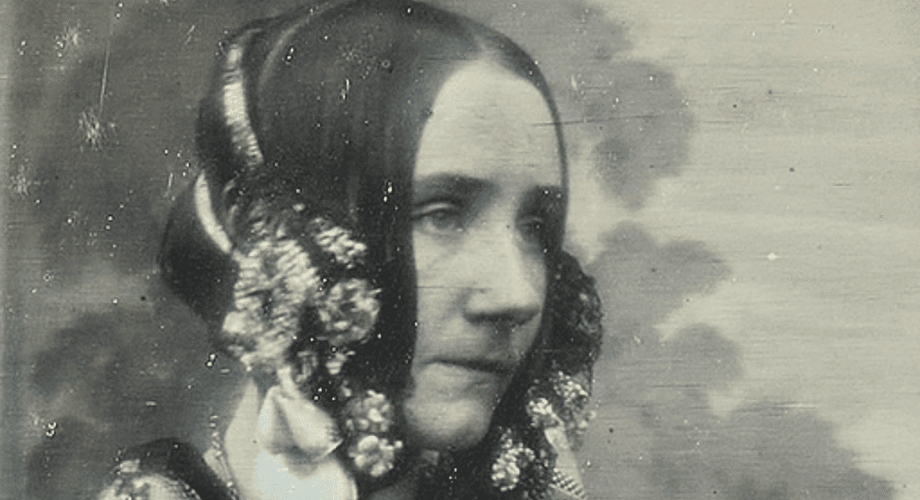
Who was Ada Lovelace?
Lovelace was the only legitimate child of poet Lord Byron and reformer Anne Isabella Milbanke.
Soon after Ada's birth, Lord Byron separated from his wife. Though at that time, custody was offered to the father, he made no attempt to claim his parental rights so Ada never met her father. He left and died when Ada was eight.

At the age of eight, Ada experienced headaches that affected her vision. In June 1829, she was paralyzed after some measles complications. By 1831, she was able to walk with crutches. Although often ill, Lovelace pursued her studies diligently, developing continouslly her mathematical and technological skills.
In 1835 she married William King. King was a Baron and became Viscount Ockham and 1st Earl of Lovelace in 1838.

The name Lovelace was chosen because Ada was descended from the extinct Baron Lovelaces. Because of her husband's title, Ada became the Countess of Lovelace.
They had three children: Byron (born 1836); Anne Isabella (called Annabella, born 1837); and Ralph Gordon (born 1839)
Ada's life was not without scandals. She was rumored to have had extra marital affairs as well as gambling problems. She formed a syndicate with some friends and in 1851 she had an attempt to create a mathematical model for successful large bets, but it went wrong, leaving her in debt to the syndicate and finally being forced to disclose all of it to her husband.
Education
Starting at age seventeen in 1832, Ada Lovelace’s mathematical talents started emerging. This path was largely set by her mother, who insisted on a rigorous education in logic and science as an antidote to the perceived "insanity" of Ada’s father, Lord Byron.
Guided by distinguished mentors like Mary Somerville and later Augustus De Morgan, Ada mastered advanced calculus and the complex Bernoulli numbers that would eventually fuel her groundbreaking algorithm for the Analytical Engine.

De Morgan was so impressed by her progress that he predicted she would become a "first-rate" original investigator in the field.
Lovelace believed that intuition and imagination were critical to effectively applying mathematical and scientific concepts. She valued metaphysics as much as mathematics, viewing both as tools for exploring "the unseen worlds around us".
Lovelace often questioned basic assumptions through integrating poetry and science. Whilst studying differential calculus, she wrote to De Morgan:
Other private tutors in mathematics and science were William Frend and William King
Ada became very close friends with her Mary Somerville, 19th-century researcher and scientific author, for whom she had a strong respect, and they corresponded for many years. In 1833, Mary Somerville introduced her to Charles Babbage.
Work
Soon after meeting her, Babbage invited Ada to see his prototype for his difference engine. Ada became immediately fascinated with the machine and used her relationship with Somerville to visit Babbage as often as she possibly could. Babbage in return was so impressed by Ada's intellect that he called her "The Enchantress of Number"

In 1840, Charles Babbage was invited to give a seminar at the University of Turin about his Analytical Engine. Luigi Menabrea, future Prime Minister of Italy, transcribed Babbage's lecture in French language, and in 1842 was published in the Bibliothèque universelle de Genève: "Notions sur la machine analytique de Charles Babbage"
Charles Wheatstone, a friend of Charles Babbage, asked Ada Lovelace to translate Menabrea's paper into English.
Between 1842-1843 Ada spent nine months translating the article. She created seven notes, from A to G, being three times longer than the translation, which then were published in September 1843 in the Taylor's Scientific Memoirs under her initials AAL.
Note G, especially, described in detail a method for calculating a sequence of Bernoulli numbers using the Analytical Engine. If the Analytics Engine were to be built, this method quite possibly would have run correctly. Meaning most probably no bugs, as we know error today.

It is important to mention that though Charless Babbage's earlier notes from 1837 -1840 do contain the first programs for the engine, the algorithm in Note G is often called the first published computer program.
Babbage claimed credit in his autobiography for the algorithm in Note G. There are many who oppose the idea that Ada Lovelace wrote the first algorithm, even saying she did not have the knowledge to do so. But if she didn't have the knowledge, how could she possibly find and correct bugs in Babbage's programs? Which she did.
Many acknowledge that Babbage had written programs for the engine quite before Ada Lovelace, but the programs didn't compare with Ada's work.
Ada realised early on the potential of the device and that it extended beyond mere number crunching.
Though there was a falling out with Babbage, they soon rekindled their friendship, Ada even asking him to be her executor after her death, though that letter had no legal authority.
After her work with Babbage, Lovelace continued to work on other projects. Her interest in scientific development never faded.
In 1844, she told a friend, Woronzow Greig, about her desire to create a mathematical model for how the brain gives rise to thoughts and nerves to feelings. She was indeed a pioneer in her way of thinking. She saw things many didn't.
Though her work was never tested because the machine was never built, her notes were the foundation of modern computing.
Her death
Ada passed away on 27 November 1852, after month battling cervical cancer. During her months of illness, her mother excluded all her friends and confidants and became her executor.
At her oen request, she was buried next to her father at the Church of St. Mary Magdalene in Hucknall, Nottinghamshire.
A lasting legacy
Ada Lovelace passed away at the young age of 36, but her contributions lived on. Her notes were rediscovered in the mid-20th century, providing a vital link for pioneers like Alan Turing.
Today, Ada Lovelace Day is celebrated every October to honor the achievements of women in Science, Technology, Engineering, and Mathematics (STEM). She remains a symbol of how the union of creativity and logic can change the world.